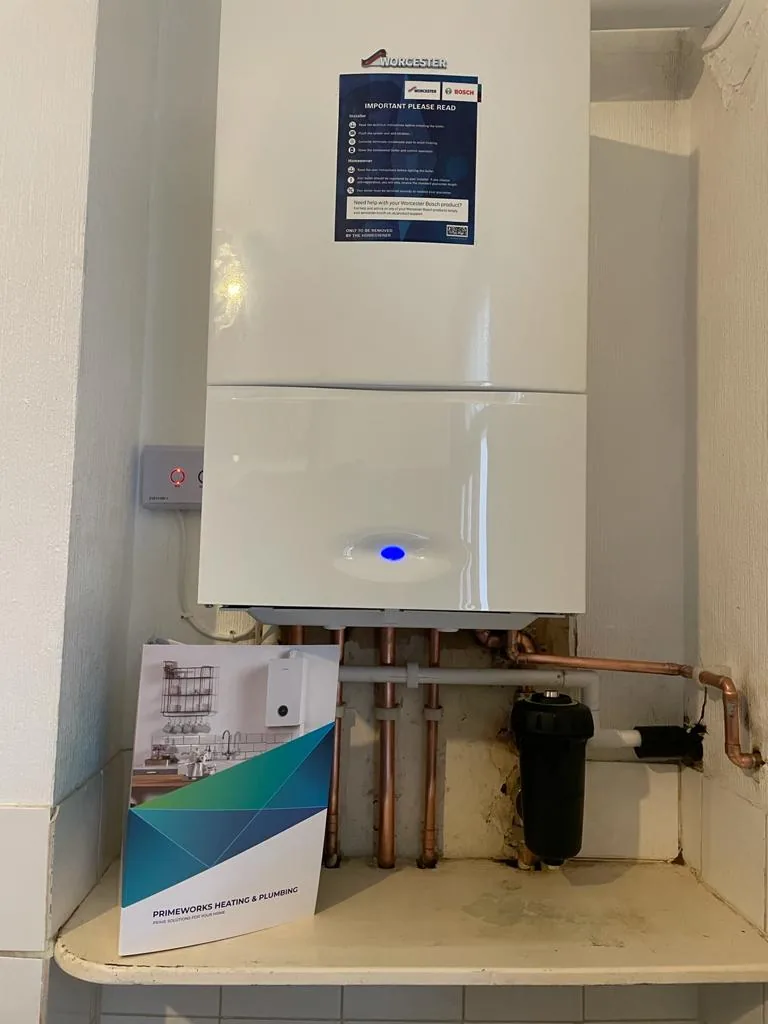
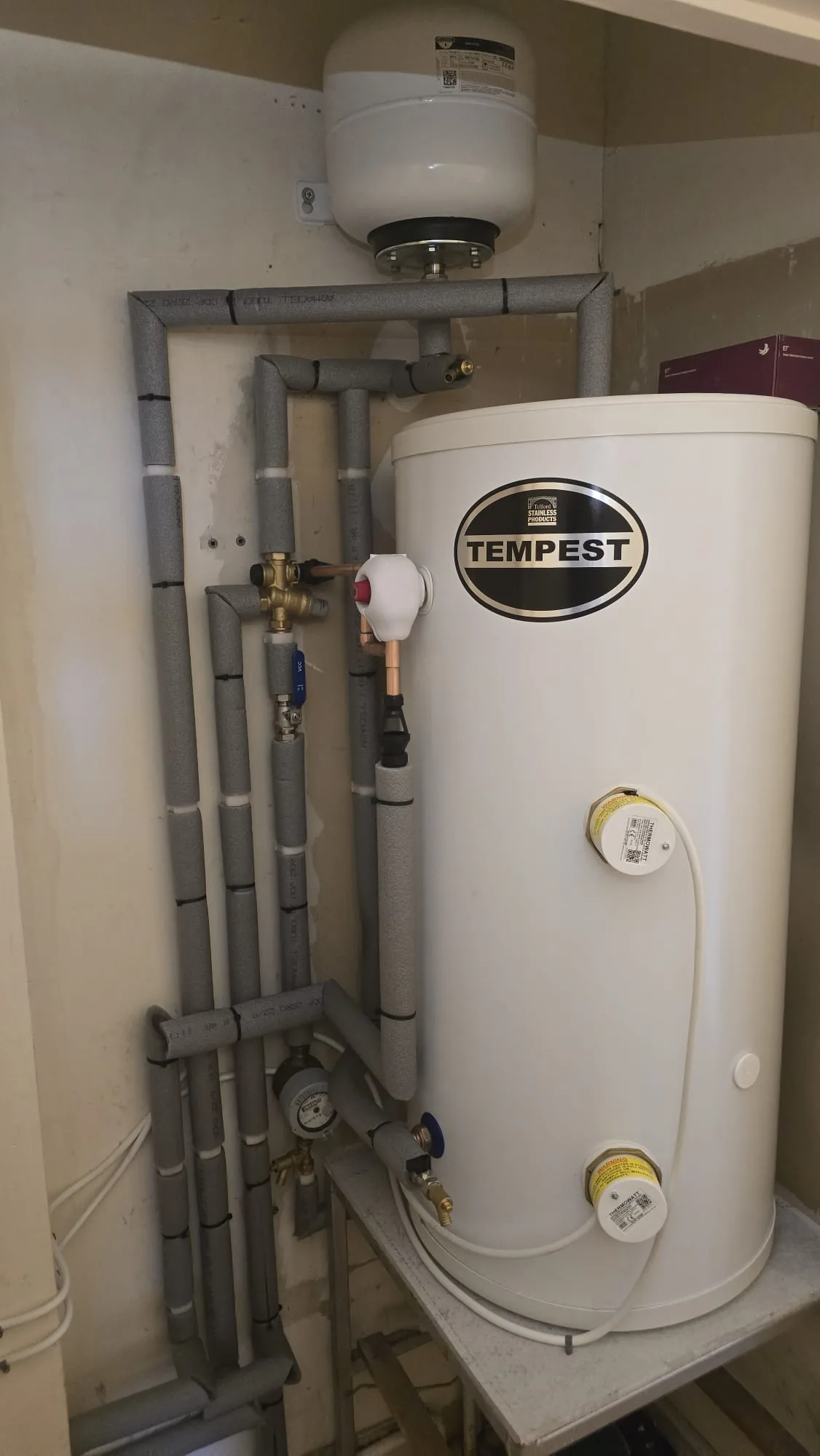
If you've ever stood under a weak shower while the kitchen tap was running and wondered why, the answer probably lives in your loft. A traditional gravity-fed hot-water system relies on a cold-water tank up there to feed your taps. The pressure is whatever gravity hands you. An unvented cylinder swaps that arrangement out for a direct mains feed, and the difference at every outlet is night and day. Here's how unvented cylinders work, when they make sense, and what to look for when you're getting one installed.
What is an Unvented Cylinder?
An unvented cylinder is a hot-water storage tank that takes its cold-water feed straight from the mains, rather than from a tank sitting open to the atmosphere in your loft. Because it's sealed and pressurised, the hot water it delivers comes out at mains pressure too, so every outlet in the home runs at the same strong flow whether the shower upstairs is on or not.
- No loft tank: The cold feed comes from the rising main, so the loft can be cleared of the old tank and feed pipework.
- Stored hot water: Unlike a combi boiler that heats on demand, an unvented cylinder stores 150 L–300 L of hot water, ready to deliver.
- Sealed system: The cylinder is closed to the atmosphere, fitted with safety valves to manage pressure and temperature build-up.
How It Works
The cylinder sits in an airing cupboard or utility room. Cold water enters under mains pressure, is heated either by an immersion element, a boiler, or both, and is then drawn off through the hot taps at the same mains pressure. Two key safety features are built in by Building Regulations Part G3:
- Expansion vessel: A small bladder tank that absorbs the volume change as the water heats up. Without it, the pressure would creep up over time and lift the safety valves.
- Temperature and pressure relief valves: Two independent valves that dump water down a dedicated discharge pipe if the cylinder ever overheats or over-pressurises. Both are non-negotiable.
When It's the Right Call
Unvented cylinders shine when you've got a household that uses a lot of hot water across multiple outlets at the same time, when the property has good incoming mains pressure, and when you'd like to reclaim the loft.
- Multi-bathroom homes: Two or more bathrooms running showers at once is where an unvented system pulls ahead of both gravity systems and combi boilers.
- Loft conversions: If you're putting a bedroom or office in the loft, the old water tank has to go anyway, and an unvented cylinder is the natural replacement.
- Strong incoming mains: Most modern South-East London supplies are fine, but we run a free mains pressure and flow test before quoting to be sure.
- Older properties with weak shower flow: Victorian terraces with the original gravity system often jump from "tolerable" to "actually enjoyable" once the cylinder is in.
If your incoming mains is weak (rare but it happens), there are pump-boosted options to discuss, but a combi or system boiler may also be the simpler answer. A real survey is the only way to know.
Considering an Unvented Cylinder?
Call Primeworks Heating on 07534 469 008 for a free mains pressure test and a fixed quote across South-East London.
Call for a Free QuoteWhat to Expect on Install Day
A typical unvented cylinder install runs over one to two days, depending on the existing pipework and whether old loft tanks are coming out. Here's the usual sequence at a Primeworks job:
- Survey and mains test (free): 30 minutes on site. We measure incoming mains pressure and flow rate at the kitchen tap and confirm the cylinder size is a good match for the household.
- Day 1 morning, drain-down: Old gravity system is drained, redundant cold-water tank and feed pipe in the loft are isolated, and the discharge route for the new cylinder's safety pipework is planned.
- Day 1 afternoon, fit and pipework: Cylinder is lifted into position, secured, and connected to mains, hot-water draw-off, vent, and discharge. Expansion vessel and safety valves go on at the same time.
- Day 2, commissioning: System is filled, pressurised, and tested at every outlet. Safety valves are verified, the Building Regs G3 notice is issued, and the homeowner is walked through the controls.
- Clean-up: Old tanks, packaging, and debris all leave with us. Loft space is reclaimed.
Why a G3 Qualification Matters
Unvented systems run at mains pressure and store a substantial amount of hot water. If the safety valves are wrong, the discharge isn't routed correctly, or the system is plumbed in by someone who doesn't understand the regulations, the failure mode is genuinely dangerous. That's why Building Regulations Part G3 makes installation by a G3-qualified engineer a legal requirement.
- Legal requirement: Only a G3-qualified engineer can sign off the installation. Non-qualified work has no Building Regs notice and is not insurable.
- Insurance and resale: Mortgage lenders, home insurers, and buyers all ask for the G3 notice when the property changes hands.
- Warranty: Cylinder manufacturers void their warranty if the system isn't fitted by a G3-qualified engineer.
- Safety: Most importantly, a G3-qualified engineer routes the discharge pipework where it has to go (and not where you'd be tempted to hide it), tests every safety valve, and submits the notification.
Every Primeworks engineer who fits an unvented cylinder holds the G3 qualification. Ask any installer for their G3 cert before they start work, and check it carries the right date.
Frequently Asked Questions
A rough rule of thumb is 35 L–45 L of cylinder capacity per person per day. A four-person, two-bath household typically lands on 200 L–250 L. We confirm the size on the survey based on actual demand patterns, not just headcount.
If the cylinder is sized correctly, no, not under typical use. The cylinder reheats while you're using hot water, and the size is picked so demand and reheat broadly keep pace. If two long showers and a bath run back to back, even a generous unvented cylinder will eventually need to reheat. We talk through realistic peak-use scenarios on the survey.
Yes. Every unvented cylinder install is notifiable under Building Regulations Part G3. A G3-qualified engineer self-certifies the work and the notice lands with your local authority. Keep a copy for the property file, you'll want it for resale.
No. The discharge pipe (D2) must terminate somewhere safe where boiling water at high pressure won't injure anyone, and it has to follow specific gradient and routing rules. Sometimes that constraint drives where the cylinder goes; we'll explain the constraints on the survey before committing to a location.
Annually, alongside the boiler. The service includes checking the expansion vessel charge pressure, testing the temperature and pressure relief valves, and inspecting the anode (for cylinders that have one). Skipping the annual service shortens the cylinder's life and can invalidate the warranty.
Not usually, no. Combi boilers heat water on demand and don't need a separate cylinder. If you've got a combi and you want stored hot water, the right answer is to switch to a system boiler with the cylinder, not to bolt a cylinder onto the combi.